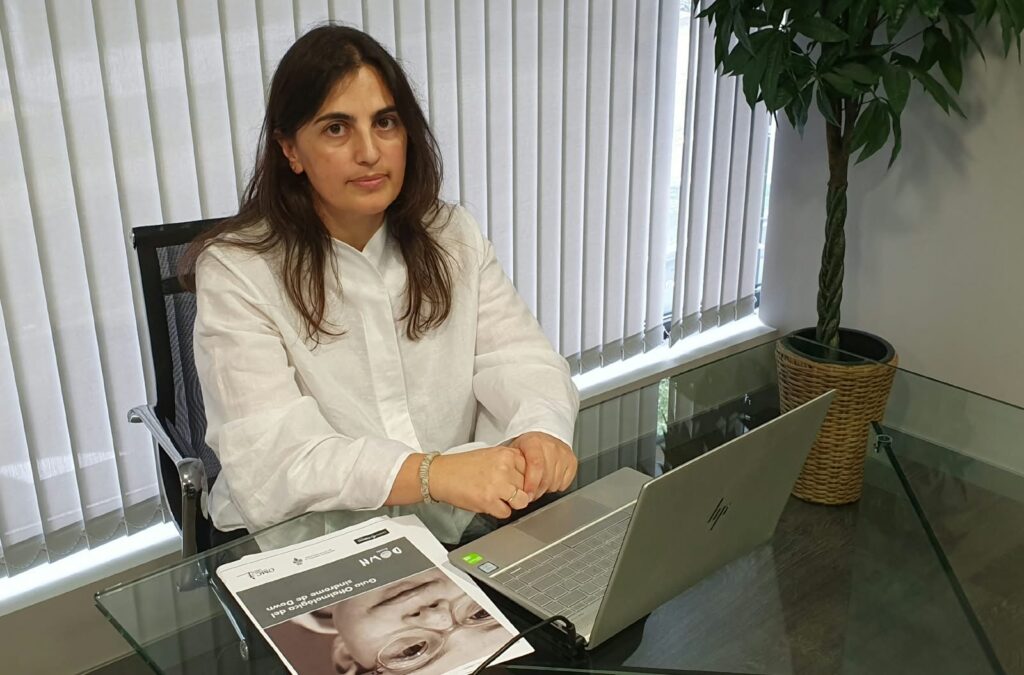
Eye health, a priority from the first months of life for people with Down Syndrome
Eye health should be a priority from the first months of life for people with Down Syndrome. This was highlighted during the webinar “Caring for Their Vision: Eye Health in People with Down Syndrome,” organized by Down España and presented by Dr. María Santiago, a pediatric ophthalmology specialist at Miranza Instituto Gómez-Ulla.
One of the key messages of the session was the need for regular ophthalmological check-ups from childhood, given that between 60% and 70% of people with Down Syndrome will experience some form of vision problem during their lifetime that may require treatment or intervention. Current recommendations establish that the first eye examination should take place during the first three months of life to rule out the presence of congenital cataracts, which in most cases require immediate intervention. If no eye condition is detected, the next examination should take place at around two and a half years of age, followed by annual ophthalmological check-ups from that point onwards throughout life.
Miranza Instituto Gómez-Ulla emphasizes that pediatric examinations should pay particular attention to visual acuity, the presence of cataracts, extraocular motility, and refractive errors. In adults, in addition to assessing visual acuity, a complete biomicroscopic examination should be performed to look for eyelid, corneal, or lens pathology.
Visual examinations for patients with Down Syndrome should be carried out regularly to monitor their eye health. These check-ups make it possible to identify and correct any visual impairment at an early stage, helping to ensure optimal visual health for people with Down Syndrome.
Nearly half of children with Down Syndrome have some form of strabismus
During the session, which was aimed at families and healthcare professionals, the specialist explained that people with Down Syndrome have a higher incidence of visual disorders that can affect their development, learning, and quality of life.
Among the most common conditions are refractive errors such as myopia, hyperopia, and astigmatism. Around 37% of people with Down Syndrome have hyperopia, 18% have myopia, and almost half have astigmatism, according to the Ophthalmological Guide on Down Syndrome published by Down España. In most cases, these problems can be corrected with glasses, making a significant contribution to improving independence.
Dr. Santiago also discussed strabismus and nystagmus, conditions that occur more frequently in people with Down Syndrome than in the general population. Nearly half of children with Down Syndrome have some form of strabismus, with inward deviation of the eyes being the most common type. Likewise, up to 15% have nystagmus, a condition that can cause a significant reduction in visual acuity.
Up to 80% of cases of torticollis may have an ophthalmological cause
One of the issues that generated the greatest interest among families was the relationship between certain visual problems and postural abnormalities. According to the Ophthalmological Guide on Down Syndrome, up to 80% of cases of torticollis in people with Down Syndrome may be due to an identifiable ophthalmological cause, the treatment of which can significantly improve the condition.
The specialist also devoted part of her presentation to cataracts, emphasizing the importance of identifying them early in order to prevent irreversible consequences for visual development. Cataracts can present differently depending on age and, although they do not always require surgery, early detection is essential because they can compromise visual acuity.
The webinar also addressed other less prevalent conditions, including blepharitis, lacrimal fistulas and tear duct obstructions, retinal disorders, and keratoconus. The latter has a high prevalence among people with Down Syndrome and may manifest as a progressive increase in astigmatism or a reduction in vision. Early detection makes it possible to use less invasive treatments and better preserve visual function.
The session concluded with a question-and-answer segment in which families were able to address their concerns about symptoms, treatments, and follow-up guidelines. This highlighted the strong interest surrounding eye health in people with Down Syndrome and the importance of having access to specialized and accessible information.