 Book an appointment
Treatments
Refractive surgery with intraocular lenses
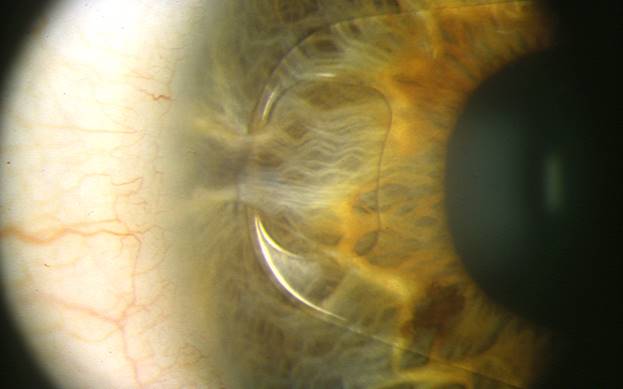
What is refractive surgery with intraocular lenses?
Intraocular lens implantation is a procedure that has been growing in recent years for the surgical correction of refractive errors. In fact, new models are constantly appearing, which we offer as forerunners with all guarantees for our patients, once their good results have been shown in clinical studies, which we participate in at the Miranza clinics.
- Phakic lenses: We place them between the cornea and the crystalline lens; thus, as they do not replace any eye structure, they are a reversible procedure. They are usually indicated for younger patients.
Moreover, depending on the focus provided by these lenses, we can also talk about:
- Monofocal lenses: they correct one single focus, as they are optimised for near or far vision. They are specially used in young patients that have no other visual problems, apart from their refractive error.
- Trifocal lenses: allow you to see well both near, intermediate and far. They are usually recommended in older patients, with presbyopia or cataract.
- Extended-focus lenses: They have appeared more recently and increase the depth of focus compared to monofocal lenses, while avoiding some of the disadvantages that can be associated with trifocal lenses (such as halos, glare or loss of contrast).
Finally, there is another classification, depending on the refractive error that it is corrected:
- Standard lenses: they correct myopia, hyperopia or presbyopia.
- Toric lenses: besides, they also correct astigmatism.
Technological progress has not only allowed the introduction of new lens designs, but also more accurate equipment to calculate their power in each case and intelligent platforms in the operating room that allow their perfect positioning in the eye.
Vision problems treated by refractive surgery with intraocular lenses
Refractive surgery with intraocular lenses is an effective and safe alternative to the use of glasses or contact lenses, which you can choose if you have high levels of myopia, hyperopia and/or astigmatism or, for other reasons (such as a fragile cornea), it is preferable for us to perform this technique instead of laser refractive surgery.
On the other hand, if we implant a pseudophakic intraocular lens, especially common in cases of presbyopia or “eyestrain”, we will correct this refractive error and prevent you from developing cataracts in the future (link), as we will have already replaced the lens, which, in addition to losing its ability to focus, also becomes opaque over the years.
Since the characteristics of each eye and the visual needs of each person are different, we recommend that you see an ophthalmologist you trust, who will advise you on the technique and type of lens best suited to you. A good preliminary diagnostic study and an accurate surgical indication are the first steps towards successful surgery.




Recovery
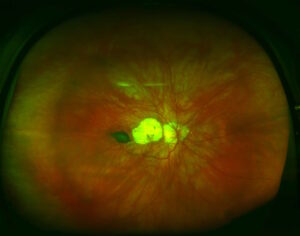
Refractive surgery with intraocular lenses is an outpatient procedure we usually perform under topical anaesthesia (drops) and that does not take more than 15 to 20 minutes. We will usually operate on one eye first and, a few days later, on the other to ensure your good progress. You will soon notice that your vision has recovered and be able to resume your daily activities, except for some basic eye care and precautions your ophthalmologist will indicate, such as avoiding impacts or sudden efforts during the first weeks, performing good hygiene and complying with the indicated antibiotic and anti-inflammatory treatment.
Once you wear your custom-made intraocular lenses, you will see that they are completely unnoticeable.
Risks
Frequently Asked Questions
A phakic lens is an intraocular lens implanted inside the eye without removing the natural lens. It can be used to correct certain refractive errors, especially when the characteristics of the cornea make laser corneal surgery inadvisable or when the prescription is high.
Intraocular lenses can be an alternative for certain patients with myopia, especially when the prescription is high or the characteristics of the cornea do not allow laser surgery to be performed under suitable conditions. The indication is established after a complete eye assessment.
Laser surgery reshapes the cornea to correct the prescription, while an intraocular lens corrects it using a lens placed inside the eye. The choice depends on age, prescription, the cornea, the condition of the natural lens and other eye characteristics.
For certain patients with high myopia there are various surgical alternatives, although a laser corneal technique is not always advisable. Depending on the prescription and the characteristics of the eye, other options may be considered, such as certain intraocular lenses.
Yes. Phakic intraocular lenses can be an alternative for certain patients with high myopia. Before the procedure is indicated, the anatomy of the eye, the prescription and eye health need to be examined to determine whether this option is appropriate.
A thin cornea can limit or rule out certain laser refractive surgery techniques, as sufficient corneal tissue needs to be preserved. For some patients there may be alternatives, such as certain intraocular lenses. The pre-operative assessment makes it possible to determine which options are available.
Keratoconus may rule out certain laser refractive surgeries, as it affects the structure and stability of the cornea. It is essential to perform corneal topography or tomography to detect abnormalities and determine which treatment options are appropriate.