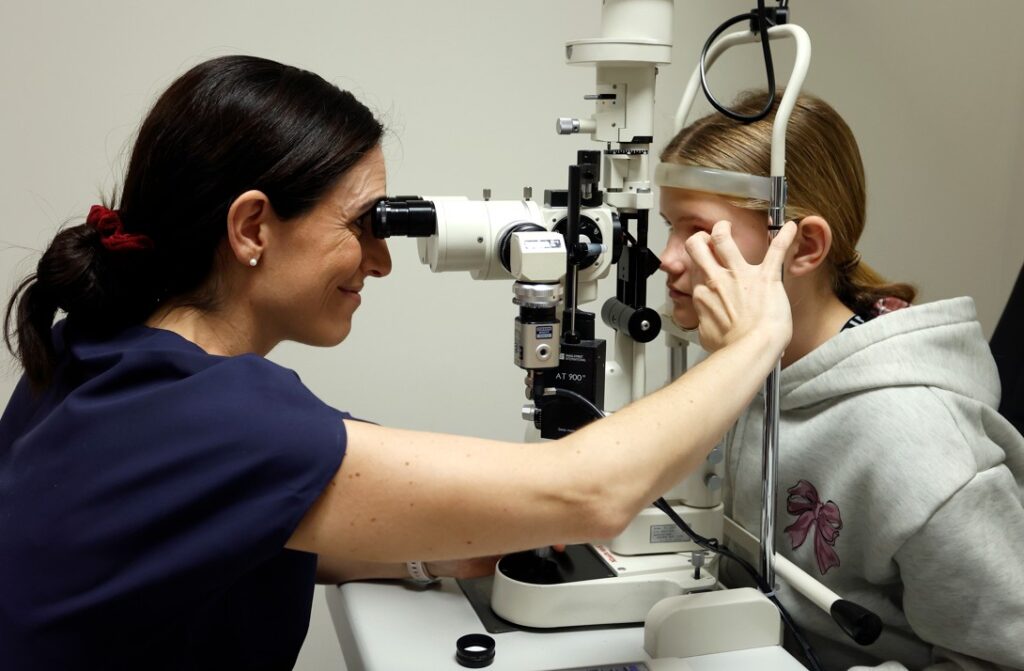
Acting before age 10 is key to preventing vision loss caused by “lazy eye”
Myopia, hyperopia, astigmatism, strabismus and amblyopia (commonly known as lazy eye) are among the most common visual disorders in childhood.
As the new school year begins, thousands of children return to the classroom to embark on a period marked by new learning experiences. In this context, specialists at Miranza remind parents that, in addition to preparing backpacks and books, it is important to check that their children’s eye health is in good condition so they can start the academic year with the best possible visual health.
Around the age of four, children begin developing the skills that will form the foundation for reading and writing. Good eye health facilitates this learning process and supports attention and academic performance, while an undiagnosed visual problem can make it difficult to read, write and follow classroom activities.
Dr. María Concepción Guirao, a specialist at Vissum Grupo Miranza, explains: “When children begin working on reading and writing skills, it is essential that they feel visually comfortable so they can develop their full potential. An ophthalmological examination before the start of the school year can detect possible visual problems and ensure that children begin this stage with the best possible conditions for learning”.
A crucial period
La ambliopía u ojo vago, la miopía, la hipermetropía, el astigmatismo y el estrabismo son algunas de las alteraciones oculares más frecuentes durante la infancia. La mayoría de ellas pueden tratarse de forma eficaz siempre que se detecten durante los primeros años de vida, cuando el sistema visual todavía se encuentra en pleno desarrollo.
Amblyopia, or lazy eye, myopia, hyperopia, astigmatism and strabismus are among the most common eye conditions during childhood. Most can be treated effectively as long as they are detected during the early years of life, when the visual system is still developing.
Dr. Guirao points out that, in the case of lazy eye, the problem is not limited to the eye itself: the brain has not properly developed its ability to see. During the first years of life, the brain learns to interpret the images it receives from the eyes and establishes the neural connections required for normal vision.
“A brain may fail to learn to see correctly for different reasons. In some cases, this may be because the structures of the eye are not functioning properly, as can occur in children with retinal disorders or keratoconus, for example”, the specialist explains.
In other cases, the problem may be caused by a refractive error that leads to amblyopia, or lazy eye. “When we correct that refractive error with the appropriate prescription, we ensure that a sharp image reaches the brain. If the brain does not receive a clear image during its development, it cannot learn to interpret visual information correctly”, the doctor explains.
Between birth and the age of eight, there is a period of significant brain plasticity during which the brain has a greater capacity for visual learning. “If we intervene during this stage, we can resolve the problem”, adds Dr. Guirao.
In this regard, the specialist warns about the consequences of a late diagnosis. “If a child needed glasses and the problem was not addressed in time, even if the refractive error can be corrected through surgery in adulthood, the quality of vision cannot always be fully restored because the brain will not have properly developed the neural connections responsible for visual learning”.
Prevention also starts at home
In addition to regular eye examinations, the ophthalmologist points out that preventing certain eye problems also depends on habits developed during childhood, particularly at a time when the use of electronic devices is part of everyday life for many schoolchildren.
To help prevent and slow the progression of myopia, the doctor recommends that children spend at least two hours a day engaged in outdoor activities whenever possible. She also advises reducing screen time and encouraging responsible use of technology.
Dr. Guirao adds: “When it is necessary to use a mobile phone, tablet or computer, it is important to do so with good ambient lighting, maintain a distance of more than 20 centimetres from the screen and take regular breaks to prevent eye strain”.