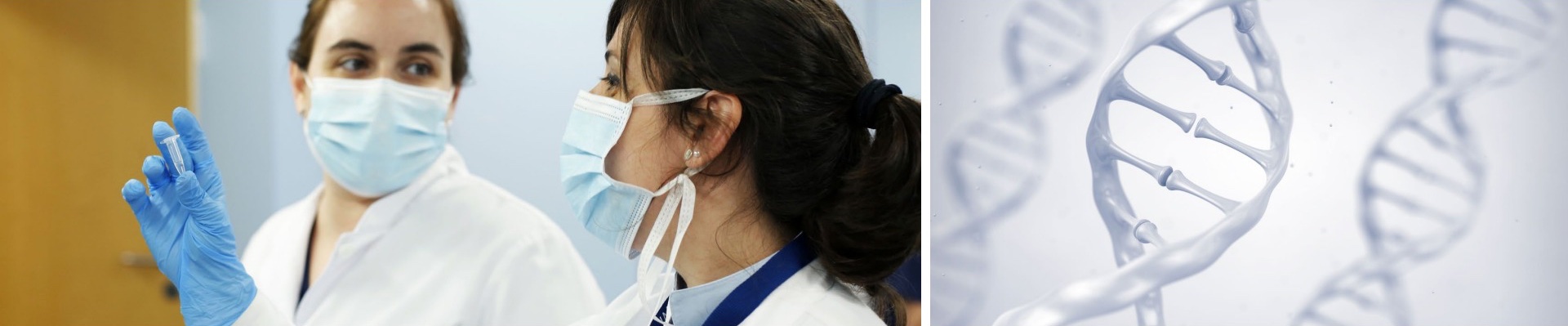
Genetic diagnosis and counseling at Miranza
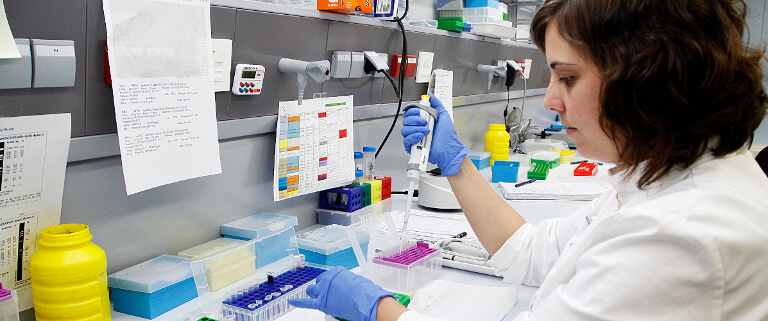
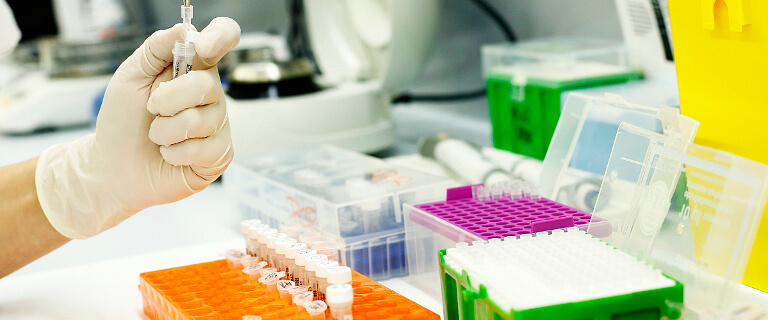

What is a hereditary disease?
Hereditary diseases usually have the following characteristics:
- They are passed down within the same family
- They are caused by a gene alteration
- They can follow different inheritance patterns
Most hereditary eye diseases are rare and affect fewer than 1 in 2,000 people. At Miranza, we provide genetic diagnosis and counseling for more than 50 hereditary conditions that affect vision.
Book an appointment for a genetic diagnosis teleconsultation
What is genetic diagnosis used for?
Genetic diagnosis allows us to:
1

Confirm the clinical diagnosis of a condition, as some diseases have similar symptoms and/or can be difficult to diagnose.
2

Understand how the disease will progress, since prognosis may vary depending on the type of genetic alteration.
3

Inform the affected family. A genetic counseling visit is carried out to identify the most likely inheritance pattern—that is, how the disease may be passed on within the family.
4

Alert family members who may be carriers, as they could pass on or develop the disease in the future.
5

Prepare the affected patient for future gene and cell therapies.
6
Improve knowledge of hereditary diseases and identify new responsible genes.
Book an appointment for a genetic diagnosis teleconsultation
Should I undergo a genetic study?
We recommend requesting a genetic study if you meet any of these conditions:
1

There is a history of hereditary or recurrent eye diseases in your family.
2

You have been diagnosed with a hereditary eye disease.
3

You want to have children and there are cases of hereditary eye diseases in your family or your partner’s family.
4

One of your children has a hereditary eye disease.
Pioneers in diagnosis and research
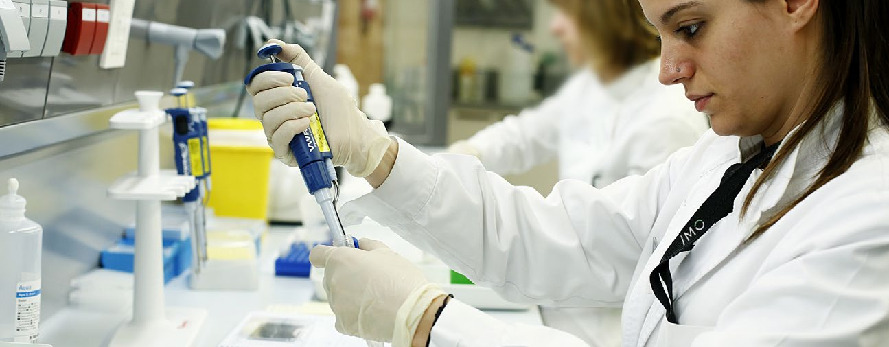
IMO Grupo Miranza Barcelona is the only ophthalmology center in Spain with its own molecular biology laboratory and a pioneer in the genetic diagnosis of hereditary eye diseases. This service is available to all patients across our national network of clinics. At this laboratory, we also carry out ambitious basic research projects promoted by Miranza’s R&D&I area through Fundación IMO.
How is genetic diagnosis performed?
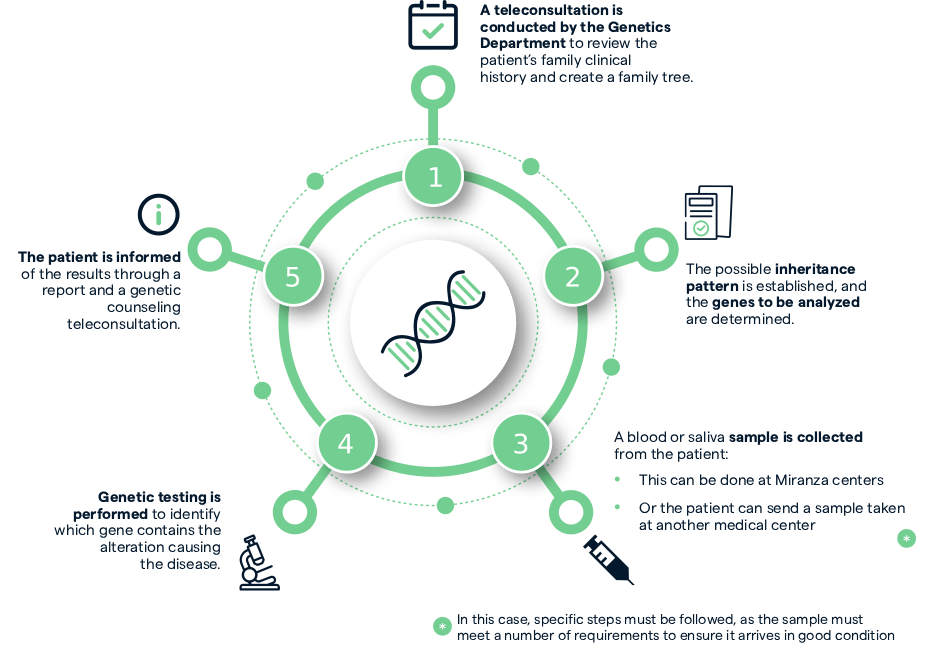
Once the ophthalmologist has made a clinical diagnosis, the genetic study is carried out in 5 steps:
How is genetic diagnosis performed?
Once the ophthalmologist has made a clinical diagnosis, the genetic study is carried out in 5 steps:
1

A teleconsultation is conducted by the Genetics Department to review the patient’s family clinical history and create a family tree.
2

The possible inheritance pattern is established, and the genes to be analyzed are determined.
3

A blood or saliva sample is collected from the patient:
- This can be done at Miranza centers
- Or the patient can send a sample taken at another medical center
4

Genetic testing is performed to identify which gene contains the alteration causing the disease.
5

The patient is informed of the results through a report and a genetic counseling teleconsultation.
More than 50 conditions,
with over 800 genes involved
These are the hereditary eye diseases for which Miranza offers genetic diagnosis and counseling:
Achromatopsia · Ocular albinism · Oculocutaneous albinism · Leber congenital amaurosis · Aniridia · Gyrate atrophy · Autosomal dominant optic atrophy
BBlepharophimosis: Autosomal recessive bestrophinopathy
CCongenital cataract · Congenital stationary night blindness · Choroideremia
DMeesmann corneal dystrophy · Cone-rod dystrophy · Lattice corneal dystrophy · Cone dystrophy · Sorsby dystrophy · Fuchs endothelial dystrophy · Congenital hereditary endothelial dystrophy · AMD (age-related macular degeneration)
EBest disease · Norrie disease · Stargardt disease
FCongenital fibrosis of the extraocular muscles
GCongenital glaucoma · Juvenile glaucoma · Primary open-angle glaucoma (familial)
MMicrophthalmia
NNanophthalmia · Leber hereditary optic neuropathy
PCongenital and acquired ptosis
RRetinoblastoma · Retinitis pigmentosa · Retinoschisis
SAxenfeld-Rieger syndrome · Bardet-Biedl syndrome · Donnai-Barrow syndrome · Joubert syndrome · Marshall syndrome · Rothmund-Thomson syndrome · Senior-Løken syndrome · Stickler syndrome · Usher syndrome · Wagner syndrome
VFamilial exudative vitreoretinopathy
Book an appointment for a genetic diagnostic teleconsultation
 GENETICS DEPARTMENT
For more details, please don’t hesitate to contact our Genetics Department: [email protected]