 Book an appointment
Treatments
Lens Surgery
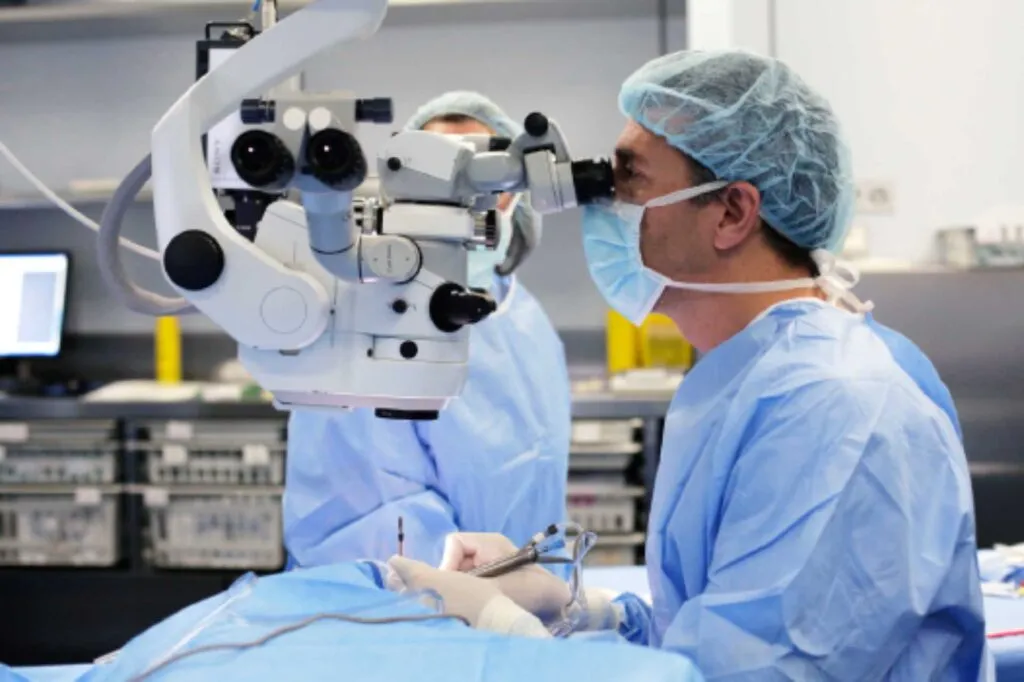
What is lens surgery?
The procedure of replacing the natural lens with intraocular lenses, known as pseudophakic lenses, not only overcomes the loss of focusing ability (presbyopia) or the opacity of an ageing lens (cataract), but also corrects refractive errors that existed before this problem (myopia, hyperopia or astigmatism).
Today, lens surgery with the implantation of multifocal lenses provides independence from glasses for all distances in most cases. However, not all patients are suitable candidates for multifocal lenses, and some people may benefit more from other types of lenses, such as EDOF (Extended Depth of Focus) lenses, which are specially designed to optimise distance and intermediate vision (such as computer distance).
The quality of the materials and the optical design of intraocular lenses are constantly evolving, and new premium lens models continue to appear. Our ophthalmologists are pioneers in implanting these lenses and making them available to patients with all the necessary safety guarantees.
At Miranza clinics, we have advanced diagnostic equipment that allows us to accurately analyse eye parameters and determine which lens best suits each eye. However, when choosing the ideal intraocular lens, our ophthalmologists also consider each person’s visual needs, taking into account their profession, hobbies, lifestyle, and other factors.
In addition, Miranza specialists advise patients on the ideal time to undergo lens surgery. Today, it is the only effective and definitive method for stable correction of presbyopia.
The high level of refinement achieved by current techniques and their satisfactory results (always based on an expert and appropriate surgical indication) mean that more and more people are looking for an alternative to glasses and wish to undergo surgery for age-related vision problems. This procedure also prevents the future development of cataracts.
Vision problems treated by lens surgery
In lens surgery (refractive lens exchange), the crystalline lens, the eye’s natural lens, is replaced with an intraocular lens which, from a certain age onwards, performs its function more effectively. This is due to the natural ageing process of the eye, which causes the crystalline lens to gradually become harder and lose its ability to focus or accommodate, leading to presbyopia, commonly known as “age-related vision loss” or “blurred near vision”.
Over time, this progressive dysfunction of the crystalline lens also causes a gradual loss of its transparency, resulting in the development of a cataract. If the patient has previously undergone presbyopia surgery with the implantation of an intraocular lens, there is no longer a natural crystalline lens after the procedure on which a cataract could develop in the future.


Recovery after lens surgery
Lens surgery is a very quick procedure (it usually takes around 20 minutes) and is normally performed at the clinic under local or topical anaesthesia (eye drops), without the need for stitches in the eye.
The reduction in the size of the incision through which the intraocular lens is inserted (just around 2 mm) is one of the main advances in modern lens surgery. In addition, technological innovation (supported by the latest-generation lasers and intelligent image-guided systems) allows Miranza surgeons to achieve a high level of precision and safety in surgical outcomes, while also enabling a faster recovery.
As it is an outpatient procedure, patients can return home on the same day as the surgery. After the first few hours, an improvement in vision can usually be noticed, and within 24 hours patients can generally resume their usual activities, following certain precautions that will be explained by the ophthalmologist. It is important to follow the prescribed postoperative treatment to control inflammation and reduce the risk of infection. Postoperative check-ups are also essential to ensure proper healing and a successful recovery.