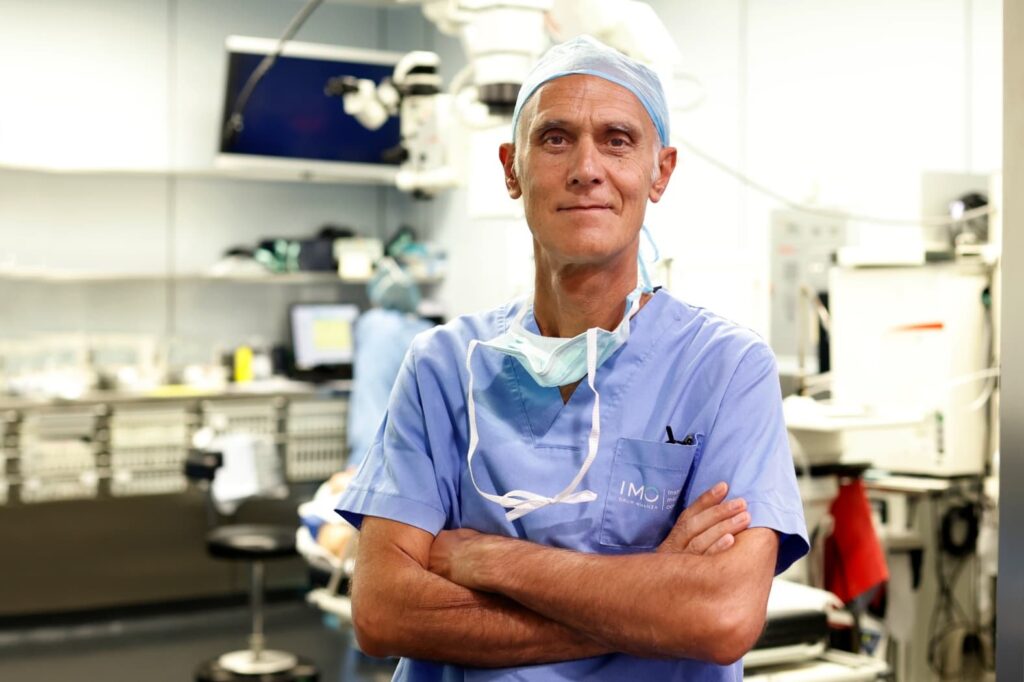
We advance research into complex endothelial transplants
Through research, Miranza, led by Dr. José Luis Güell, is developing a technique to facilitate the handling of the endothelial graft in complicated cases, as well as the temporary use of an inverted ICL for endothelial transplants in certain intraocular lens carriers.
A new leap forward in ophthalmic innovation. We have advanced the treatment of corneal endothelial diseases through the application of an endothelial transplant surgical technique (DMEK) in patients with particularly complex ocular anatomies.
Corneal endothelial diseases are conditions that affect the cells of the innermost layer of the cornea—the endothelium—damaging their fluid-pumping function and causing corneal opacity and edema.
The surgery in question, led by Dr. José Luis Güell, a specialist in corneal diseases at IMO Grupo Miranza, combines precision, innovation, and experience to deliver optimal visual outcomes, even in higher-risk cases.
Surgical innovation: Small-Bubble Guided DMEK in complex eyes
In the field of corneal endothelial transplantation, Dr. José Luis Güell has developed a surgical technique known as Small-Bubble Guided DMEK, designed for patients with previously operated eyes or complex ocular anatomies, in whom this type of transplant is particularly difficult to perform.
The endothelial graft—an extremely thin tissue obtained from a donor cornea—tends to fold onto itself, making its unfolding and positioning during surgery challenging. To overcome this difficulty, the technique is based on the very controlled injection of a small air bubble beneath the graft, which acts as temporary support during the procedure.
This bubble counteracts the graft’s tendency to roll up, facilitating a progressive, stable, and precise unfolding of the endothelial lenticule, even in anatomically demanding eyes. Once correctly positioned, intraocular gas is used to ensure firm adhesion to the posterior surface of the cornea.
The team’s experience shows that this strategy improves intraoperative control of the graft and reduces deployment time by approximately half compared with other described techniques, resulting in safer and more reproducible procedures.
According to Dr. José Luis Güell, “one of the main challenges of DMEK in complex eyes is achieving proper graft unfolding without increasing surgical risk. The small bubble provides a key point of support to handle the tissue with greater precision.”
Clinical case: protection of the intraocular lens during endothelial transplantation
In a second line of innovation, Dr. José Luis Güell and his team have developed an original surgical strategy to protect hydrophilic intraocular lenses during endothelial transplantation, based on a recently published clinical case.
During this type of surgery, intraocular gas is required to ensure proper graft adhesion to the cornea. However, in some patients with specific intraocular lenses, this gas can cause lens opacification and visual deterioration.