Miranza is leading a clinical study to evaluate 4D technology in lens surgery
We are making progress in lens surgery. Miranza Begitek has launched a comparative clinical study aimed at evaluating whether a new phacoemulsification technology allows for safer and more efficient lens surgery.
Phacoemulsification is a surgical technique used in cataract surgery that employs an ultrasonic probe to break up and emulsify the cloudy lens into small pieces. These fragments are then removed through a small incision, after which an artificial intraocular lens is implanted, allowing vision recovery.
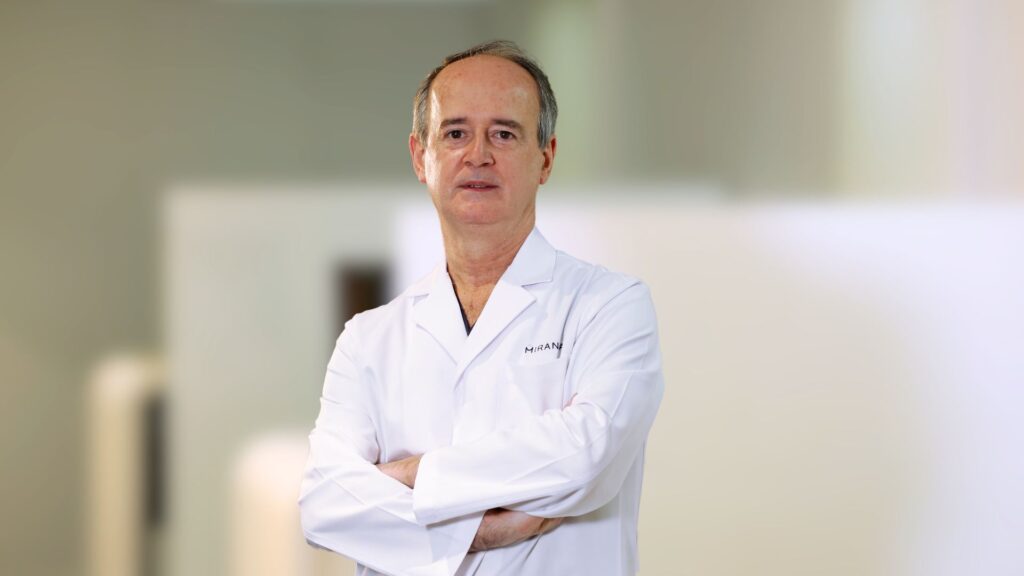
The study is led by Dr. Javier Mendicute, Medical Director of Miranza Begitek, President of CLF Miranza, and President of the Spanish Society of Implant and Refractive Eye Surgery (SECOIR). “Our commitment is clear: to scientifically evaluate every technological advance to ensure it truly improves the quality of care we provide to our patients”, says Dr. Mendicute.
A design focused on measuring safety and efficacy
The clinical trial has been designed to compare the new surgical platform with the system currently used in lens surgery. The study plans to include at least 55 patients, each undergoing surgery in both eyes, with the technology used in each eye assigned randomly.
Among the variables analyzed in the trial are total surgical time, energy dissipated during the procedure, volume of fluids used, endothelial microscopy, retinal safety parameters, and postoperative visual acuity, according to the specialist.
Surgery at more physiological pressures and with reduced tissue trauma
The research aims to verify that the new technology allows surgery to be performed with more normal intraocular pressures (below 40 mm Hg), using less energy and fluids (since excessive fluid use can damage eye cells). It also seeks to reduce phacoemulsification time and total procedure duration.
According to Dr. Mendicute, “Excessive use of energy and fluids is associated with greater endothelial damage; therefore, reducing these parameters can lead to safer surgery and faster visual recovery”.
The platform being evaluated incorporates advances that enable dynamic and synchronized management of key variables such as intraocular pressure, vacuum, energy, and temperature throughout the surgical procedure. These systems improve anterior chamber stability, optimize lens emulsification, and reduce the risk of intraoperative complications, both at the corneal and retinal levels.
“The ultimate goal is to increase the predictability and safety of surgery, especially during the most critical moments of the procedure”, says Dr. Mendicute.
Clinical impact and future research directions
If the results confirm the proposed hypotheses, this technology could become a new standard in lens surgery, benefiting both patients and surgeons through safer, more effective, and more efficient procedures, according to Dr. Mendicute.
Additionally, the research team plans to expand the analysis to more complex clinical situations. These include hard cataracts, narrow anterior chambers, pseudoexfoliation (a disorder in which whitish deposits or flakes accumulate in various parts of the eye, such as the pupil or lens), or high myopia, where the advantages of this technological approach could be even more significant, according to the specialist from Miranza Begitek.